Monday, September 11, 2017

2,974 Cold Case Murders


It's been 16 years since 2,794 people were murdered before our eyes.

Nothing has changed. 

Still, justice awaits the murderers.

There is no statute of limitations for murder.

Similar to the day President Kennedy was murdered, I remember where I was and what I was doing when the World Trade Center Towers the other five WTC buildings were destroyed, 11 Sept 2001, don’t you?

I turned the TV on that morning to see if there was some reason why my Internet connection had suddenly frozen up. Perhaps, I speculated, someone had demolished the Comcast cable somewhere close by.

Instead of a car accident, I learned that the one of the WTC towers was on fire. I didn’t know it then, but our world had changed again, once more in a very bad way.

In shock, I suspect, after seeing several people jump from the WTC, I later accepted our government’s explanation of the collapse of the impossibly huge buildings. After all, I’d seen it all on TV, hadn’t I?

Please go here for the rest of the article.


Sarah McLacklan’s I Will Remember You


Friday, September 8, 2017

Zombie USA


President Trump is many things to many people.

Here, in Michigan, for instance, he commands the respect of more than 36% of the respondents, according to an August NBC poll, while 55% say they disapprove of his performance as their President.

Mr. Trump has proven himself a feckless buffoon, a crafty self-rewarding deal maker, a predictable hissy-fit-thrower, a dangerous idiot, a megalomaniac, a racist, a misogynist, a psychopathic criminal and monumental media manipulator.

He has shown the world all of these “Trumps”.

Still, no matter which Trump presents himself today, it’s really all about results, is it not? Just what has he accomplished?

So, what are Trump’s results?

The Washington Post has done a yeoman’s work following our President’s trail. After reading the list, I can only describe my reaction: I am in shock and awe at this man’s ability to destroy the meager human rights protections we have adopted to protect common people (such as myself) from those who have and will continue to abuse us.

In only a few months, Mr. Trump has managed to unbury the rotting corpse of the American predatory capitalist system.

His legacy, your grandchildren’s legacy, will be a Zombie America.

Bobby 'Boris' Pickett & the Crypt-Kickers - Monster Mash (1962)


Wednesday, September 6, 2017

The Bloody Price Labor Has Paid... We Will Pay Again

This year, like every year, I put our flag up on Labor Day.

As it waved amid the glorious morning sunshine I thought about the life I have enjoyed.

I came from a family that stayed together during the bad times and the good. Never without food, clothing or a decent home, my brother and I, attended excellent public schools. We never feared gangs, beatings by the police, or drugs.

We were lucky. Our parents loved us. We had a great extended family, loaded with wonderful, supportive souls.

Mom, a nurse, and dad, a postman, worked their entire lives so we could live in a good neighborhood. After college, we did our time in the military and then, blessed with abundant opportunities, we pursued our careers.

Our “Good Life”, like all Americans’ “Good Life”, was built upon the sacrifices of our ancestors. They paid dearly for the good fortune we have today.

They shed blood and tears, not only on battlefields around the world, but, here at home, too. In our factories, farms and cities.

From our nation’s very beginning, they carried on multiple battles with the “powers that be”, trying to overcome terrible working conditions, slave-wages, exploitation, and every abuse imaginable perpetrated by managers and owners of businesses, police, national guard and “elected authorities”.


From 1619, when Jamestown Polish craftsmen went on strike because they were denied the right to vote, to 1971, when National Airlines management used crass sexual exploitation of its female employees in the "Fly Me" promotion, to 1986, when female flight attendants won an 18-year lawsuit against United Airlines, which had fired them for getting married, and on and on, until this very moment, when it is now our turn to pick up the torch and continue, "the pursuit of Happiness, Life and Liberty."

Each step along the way was covered with the blood of our ancestors. 

That is what Labor Day is all about… recognition of the price paid just to live and the certain knowledge that we, too, are destine to continue to pay it again.

Hard to believe, isn’t it?
Check, Wikipedia’s Timeline of labor issues and events 1619-2012


Wednesday, August 30, 2017

What's in Your Blood? Nobody Knows.


So, these guys discover that 99% of the things floating around in our blood are things we didn’t know were there.

Stop! We don’t know a single thing about them.

Wow. Now, that’s scary! Don’t you agree?

I thought these scientist people knew pretty much all about our blood and what was in it.

They don’t.

Here’s the story:

More than 99 percent of the microbes inside us are unknown to science, Stanford University, Science News, 23 Aug 2017.

"A new survey of DNA fragments circulating in human blood suggests our bodies contain vastly more diverse microbes than anyone previously understood. What's more, the overwhelming majority of those microbes have never been seen before, let alone classified and named, Stanford researchers report August 22 in the Proceedings of the National Academy of Sciences."

"We found the gamut," said Stephen Quake, a professor of bioengineering and applied physics, a member of Stanford Bio-X and the paper's senior author. "We found things that are related to things people have seen before, we found things that are divergent, and we found things that are completely novel."

Who Are You? - The Who - 1978


Tuesday, August 29, 2017

One Giant Leap for Silicon


Scientists dubbed them, "Sprites". But, they are nothing close to the lemon-line soft drink.

No, a Sprite is a tiny spacecraft on a microchip... 3.5 centimeters square and weighing four grams... and packing all the necessary tools to survive a very long distance space flight: "a solar panel, radio, thermometer, magnetometer for compass capabilities and gyroscope for sensing rotation".

To see how Sprites perform, a few days ago the Breakthrough Starshot people sent a few Sprites into space. Ultimately, Breakthrough Starshot intends on sending their little space crafts to other solar systems.

So, when a Sprite enters the Alpha Centauri system, I guess, our ancestors won't be hearing,"That's one small step for man, one giant leap for mankind."

It will be, "One small step for a micro spacecraft. One giant leap for silicon."

Still, I'll bet that Sprite won't be totin' its World Scout Badge like Eagle Scout Neil Armstrong took with him to the Moon.

Here's the story:

These chip-sized spacecraft are the smallest space probes yet, Maria Temming, Science News, 22 Aug 2017.

"Spacecraft have gone bite-sized. On June 23, Breakthrough Starshot, an initiative to send spacecraft to another star system, launched half a dozen probes called Sprites to test how their electronics fare in outer space. Each Sprite, built on a single circuit board, is a prototype of the tiny spacecraft that Starshot scientists intend to send to Alpha Centauri, the trio of stars closest to the sun. Those far-flung probes would be the smallest working spacecraft yet.

"'We’re talking about launching things that are a thousand times lighter than any previous spacecraft,' says Avi Loeb, an astrophysicist at Harvard University who is part of the committee advising the initiative. A Sprite is only 3.5 centimeters square and weighs four grams, but packs a solar panel, radio, thermometer, magnetometer for compass capabilities and gyroscope for sensing rotation."

"These spacecraft are designed to fly solo, but for this test, they hitched a ride into low Earth orbit on satellites named Max Valier and Venta-1. Each satellite has one Sprite permanently riding sidecar, and the Max Valier craft has another four it could fling out into space. Unfortunately, as of August 10, ground controllers haven’t yet been able to reach the Max Valier satellite to send a “'Release the Sprites!'” command. One of the permanently attached Sprites — probably the one on Venta-1 — is in radio contact."

"Before sending next-gen Sprites off to Alpha Centauri, scientists plan to equip them with cameras, actuators for steering and other tools. 'This was really just the first step in a long journey for Starshot,' Loeb says."

Neil Armstrong One Small Step First Walk on Moon


Neil Armstrong - Interview


Sunday, August 27, 2017

Thinking about Charlottesville …

By Gary R. Baker

Site, monument, marker, place: Ask questions. Make connections. Find out.

This summer we have been debating about monuments in public spaces – most recently in Charlottesville, Virginia. In doing so, we are thinking about the landscape of our public lives. We are also thinking about how we should live our public lives. Essential to our thinking and reflection is asking questions. Then we will have a growing sense of understanding and a deepening insight.

Gen. Robert E. Lee, Emancipation Park, Charlottesville, Va,

Along with large monuments and sculptures, we can also ask questions about and reflect on markers, plaques, and open spaces such as cemeteries and campuses. In thinking about these markers and places, we make connections between them and then establish or discover a general context. Over time, we may also wonder why a particular monument or marker or site is not present. (For example, you might consider why there is only one monument of Southern Civil War hero, Lt. General William Mahone, trusted by Robert E. Lee, and leader of the Post-Civil War Readjuster Movement.  "Mahone organized and led the most successful interracial political alliance in the post-emancipation South.")

First the individual should visit the site, walk in its territory, touch it, and read it or study it. Ask questions. What is the story of this site? What does the site mean? Reflect. Be open for insight and the beginning of understanding. Search out other sites nearby. Look for connections between sites as you ask questions and reflect. More and more people are using the expression “establish context” (or “discover context”) as they discuss a monument. To establish context, the observer or visitor must ask questions.  What happened here? What is the story of this site? What is the historical neighborhood – in both physical space and time? The observer needs to do some detective work.

In the next section I list questions that can help in this detective work. Visitors to Charlottesville, a city of 47,000, may want to test these questions at various sites and look for connections between sites. Following the questions, I suggest a few places (of many) in and near Charlottesville that will produce insights when reflected on and compared.

Questions to consider when visiting a site:
  • Where is the monument?
  • Why is it in this location?
  • When was it placed here?
  • What is the story behind the monument? Has the story changed since the monument was erected? 
  • What was the purpose of the monument? What is the purpose today?
  • Who designed it?
  • Who paid for it?
  • Has it been moved?
  • Has it been changed?
  • Has it been forgotten or ignored?
  • What is its physical condition? (Should it be repaired or cleaned?)
  • Do most people know it is here?
  • Does it continue to be part of public life?
  • What did it mean when it was first set up?
  • What does it mean now?
  • Should it be moved? Where?
  • Should it be redesignated or rededicated?
  • What have I discovered by visiting this site?
  • How significant is the monument to me personally? Why? (Personal reflection.)

Several Sample Sites: Charlottesville, Virginia, Summer 2017

Erected in 1924, an equestrian statue of Robert E. Lee stands in Lee Park (now called Emancipation Park) in Charlottesville, Virginia. Immediately after the Civil War, Lee was asked about the building of a monument to Stonewall Jackson. Lee opposed it because of the expense. Only markers and stones on individual graves would be appropriate, Lee believed.

Furthermore, constructing Confederate monuments would slow down the reunification of the country. Lee was convinced that it was time to rebuild and reunify the county – not build monuments. He even declined to meet with other Confederate and Union officers at Gettysburg to discuss a memorial there.  Lee became President of Washington College (now Washington and Lee) shortly after the war in October, 1865, and died in 1870. He is buried in the college chapel.

Slave Auction Block, Court Square, Charlottesville, VA.

Not far from the Lee monument, visitors to Court Square can see the Slave Auction Block plaque pointing out the location of the slave market – the place on the streets of Charlottesville where slaves were bought and sold.  Nearby is the campus of the University of Virginia with the Rotunda – the great library – the heart of the university with a statue of Thomas Jefferson, the founder and designer of “Virginia’s first truly public university” (“Timeline” see below.), standing in front, holding a copy of the Declaration of Independence.

Fingerprints...see NBC Dateline video below.

A few miles away on “The Little Mountain” – Monticello – where Thomas Jefferson owned over 600 slaves during his lifetime, some changes are being made to reveal the full story of all of the people who lived on the 5,000 acre plantation. Place your own fingers in the fingerprints that slaves left in the bricks when they built the outside wall of the house. Visit the Sally Hemings display, and remember the only slaves that Jefferson freed were the children of Sally Hemings (and himself?). (Monticello is a World Heritage Site.)

In your own hometown – or in the town or city where you live or work today – what are the monuments, markers, places, and sites of memory, meaning, or consequence? What are the connections between them? What are the questions that come to mind when you visit them? What are the stories? What are the contradictions? What are the puzzles? What markers should be added? What insights come to you? In your detective work, what do you find out? What does it all mean?

Background

Actually, Robert E. Lee Was Against Erecting Confederate Memorials - CNN - 17 Aug 2017
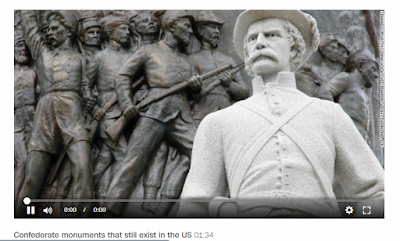
 CNN Confederate Monuments

Boyette, Chris. “Actually, Robert E. Lee Was Against Erecting Confederate Memorials.” CNN. August 17, 2017.

The Shifting History of Confederate Monuments -PBS Newshour- 14 Aug 2017


Brangham, William. “The Shifting History of Confederate Monuments.” Interview with University of Richmond historian, Dr. Edward Ayers in Charlottesville. PBS Newshour. August 14, 2017. 

Daley, Jason. “Sally Hemings Gets Her Own Room at Monticello.” Smithsonianmag.com. July 5, 2017.
Desjardins, Lisa. “Robert E. Lee Opposed Confederate Monuments.” PBS Newshour. August 15, 2017.
Schonfeld, Zach. “Robert E. Lee’s Direct Descendant Denounces Charlottesville White Nationalists: ‘There’s No Place for That Hate.’” Newsweek. August 15, 2017.

Descendants of Thomas Jefferson’s Slaves Spend the Night at Monticello - NBC Dateline -
18 Sept 2016


 NBC Dateline Descendants of Thomas Jefferson


Smith, Harry. “Descendants of Thomas Jefferson’s Slaves Spend the Night at Monticello.” Today.com. NBC. September 18, 2016. Web Video.


“Timeline of the Founding of the University of Virginia”. An article courtesy of the Thomas Jefferson Encyclopedia. Monticello.org.

Tuesday, August 15, 2017

What will “the morrow bring?”


They label themselves with innocent sounding names, like: “Alt-Right”, “Vanguard America”, “Identity Evropa”, the “Traditionalist Workers Party” and “True Cascadia”. They are proud to wear Nazi regalia and imitate the 1930s newsreel Nazis.

They are the extreme right-wing fringe of America.

No one cares.

They were like the neighbor’s kid, who delighted in pulling wings off bugs and breaking the necks of cats and squirrels. When we encountered him, we looked away and walk quickly… anywhere… far, far… away… from his evilness.

Until Charlottesville.

Charlottesville propelled the American neo-Nazi / white supremacists into their, "Andy Warhol, 15-minutes-of-fame spotlight".

Now, we must confront their evilness. There is no place to hide.

Or, maybe not, if you’re a Trumpist.

Perhaps you will say, “The black man deserved to be beaten. Next time, the white militant will use his gun and there will be no rescuers to save him from his just reward.”

We have no choice now but to wait. What will “the morrow bring?”

The following are excerpts from Greg Palast’s excellent report and Zach D. Roberts Pulitzer Prize-worthy photos, posted yesterday, on Palast's website and newsletter:

Charlottesville: A Gun In His Face, Greg Palast, gregpalast.com,14 Aug 2017.

Don’t look away.  Four white neo-Nazis are beating a Black man, crawling on the ground, with their metal poles and a yellow hunk of lumber. The beating continues – there’s blood on the pavement.

The young victim is De’Andre Harris, a special education teacher in Charlottesville.

In the photos, you can see one white guy picking up the yellow barrier arm and raising the three-foot hunk of lumber high over his head before he brings it down on Deandre—who is being kicked by another white man’s boots while two others bring down metal rods on the prone man.

And no, that’s not a cop on the left in the photo—that’s a neo-Nazi in full riot gear.  Where were the cops?  Good question:  this parking garage is next to the Charlottesville Police Station.

De’Andre was saved when some gutsy young Black men—with no weapons—ran into the underground garage– and the white posse scattered.


Except for one.  The gunman.

Our photographer, Zach D. Roberts, continues to shoot – even as a white militant raises a 9mm pistol to his face.

Zach got a shot of the gun and gunman, too. Luckily, the gunman didn’t shoot back.

Welcome to Charlottesville, USA.  Trump’s America, month eight.

Photojournalist Zach D. Roberts is Associate Producer and stake-out videographer for Greg Palast’s film, “The Best Democracy Money Can Buy.”