Showing posts with label Charlottesville. Show all posts

Sunday, August 27, 2017

Thinking about Charlottesville …

By Gary R. Baker

Site, monument, marker, place: Ask questions. Make connections. Find out.

This summer we have been debating about monuments in public spaces – most recently in Charlottesville, Virginia. In doing so, we are thinking about the landscape of our public lives. We are also thinking about how we should live our public lives. Essential to our thinking and reflection is asking questions. Then we will have a growing sense of understanding and a deepening insight.

Gen. Robert E. Lee, Emancipation Park, Charlottesville, Va,

Along with large monuments and sculptures, we can also ask questions about and reflect on markers, plaques, and open spaces such as cemeteries and campuses. In thinking about these markers and places, we make connections between them and then establish or discover a general context. Over time, we may also wonder why a particular monument or marker or site is not present. (For example, you might consider why there is only one monument of Southern Civil War hero, Lt. General William Mahone, trusted by Robert E. Lee, and leader of the Post-Civil War Readjuster Movement.  "Mahone organized and led the most successful interracial political alliance in the post-emancipation South.")

First the individual should visit the site, walk in its territory, touch it, and read it or study it. Ask questions. What is the story of this site? What does the site mean? Reflect. Be open for insight and the beginning of understanding. Search out other sites nearby. Look for connections between sites as you ask questions and reflect. More and more people are using the expression “establish context” (or “discover context”) as they discuss a monument. To establish context, the observer or visitor must ask questions.  What happened here? What is the story of this site? What is the historical neighborhood – in both physical space and time? The observer needs to do some detective work.

In the next section I list questions that can help in this detective work. Visitors to Charlottesville, a city of 47,000, may want to test these questions at various sites and look for connections between sites. Following the questions, I suggest a few places (of many) in and near Charlottesville that will produce insights when reflected on and compared.

Questions to consider when visiting a site:
  • Where is the monument?
  • Why is it in this location?
  • When was it placed here?
  • What is the story behind the monument? Has the story changed since the monument was erected? 
  • What was the purpose of the monument? What is the purpose today?
  • Who designed it?
  • Who paid for it?
  • Has it been moved?
  • Has it been changed?
  • Has it been forgotten or ignored?
  • What is its physical condition? (Should it be repaired or cleaned?)
  • Do most people know it is here?
  • Does it continue to be part of public life?
  • What did it mean when it was first set up?
  • What does it mean now?
  • Should it be moved? Where?
  • Should it be redesignated or rededicated?
  • What have I discovered by visiting this site?
  • How significant is the monument to me personally? Why? (Personal reflection.)

Several Sample Sites: Charlottesville, Virginia, Summer 2017

Erected in 1924, an equestrian statue of Robert E. Lee stands in Lee Park (now called Emancipation Park) in Charlottesville, Virginia. Immediately after the Civil War, Lee was asked about the building of a monument to Stonewall Jackson. Lee opposed it because of the expense. Only markers and stones on individual graves would be appropriate, Lee believed.

Furthermore, constructing Confederate monuments would slow down the reunification of the country. Lee was convinced that it was time to rebuild and reunify the county – not build monuments. He even declined to meet with other Confederate and Union officers at Gettysburg to discuss a memorial there.  Lee became President of Washington College (now Washington and Lee) shortly after the war in October, 1865, and died in 1870. He is buried in the college chapel.

Slave Auction Block, Court Square, Charlottesville, VA.

Not far from the Lee monument, visitors to Court Square can see the Slave Auction Block plaque pointing out the location of the slave market – the place on the streets of Charlottesville where slaves were bought and sold.  Nearby is the campus of the University of Virginia with the Rotunda – the great library – the heart of the university with a statue of Thomas Jefferson, the founder and designer of “Virginia’s first truly public university” (“Timeline” see below.), standing in front, holding a copy of the Declaration of Independence.

Fingerprints...see NBC Dateline video below.

A few miles away on “The Little Mountain” – Monticello – where Thomas Jefferson owned over 600 slaves during his lifetime, some changes are being made to reveal the full story of all of the people who lived on the 5,000 acre plantation. Place your own fingers in the fingerprints that slaves left in the bricks when they built the outside wall of the house. Visit the Sally Hemings display, and remember the only slaves that Jefferson freed were the children of Sally Hemings (and himself?). (Monticello is a World Heritage Site.)

In your own hometown – or in the town or city where you live or work today – what are the monuments, markers, places, and sites of memory, meaning, or consequence? What are the connections between them? What are the questions that come to mind when you visit them? What are the stories? What are the contradictions? What are the puzzles? What markers should be added? What insights come to you? In your detective work, what do you find out? What does it all mean?

Background

Actually, Robert E. Lee Was Against Erecting Confederate Memorials - CNN - 17 Aug 2017
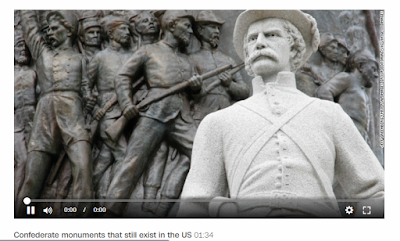
 CNN Confederate Monuments

Boyette, Chris. “Actually, Robert E. Lee Was Against Erecting Confederate Memorials.” CNN. August 17, 2017.

The Shifting History of Confederate Monuments -PBS Newshour- 14 Aug 2017


Brangham, William. “The Shifting History of Confederate Monuments.” Interview with University of Richmond historian, Dr. Edward Ayers in Charlottesville. PBS Newshour. August 14, 2017. 

Daley, Jason. “Sally Hemings Gets Her Own Room at Monticello.” Smithsonianmag.com. July 5, 2017.
Desjardins, Lisa. “Robert E. Lee Opposed Confederate Monuments.” PBS Newshour. August 15, 2017.
Schonfeld, Zach. “Robert E. Lee’s Direct Descendant Denounces Charlottesville White Nationalists: ‘There’s No Place for That Hate.’” Newsweek. August 15, 2017.

Descendants of Thomas Jefferson’s Slaves Spend the Night at Monticello - NBC Dateline -
18 Sept 2016


 NBC Dateline Descendants of Thomas Jefferson


Smith, Harry. “Descendants of Thomas Jefferson’s Slaves Spend the Night at Monticello.” Today.com. NBC. September 18, 2016. Web Video.


“Timeline of the Founding of the University of Virginia”. An article courtesy of the Thomas Jefferson Encyclopedia. Monticello.org.

Tuesday, August 15, 2017

What will “the morrow bring?”


They label themselves with innocent sounding names, like: “Alt-Right”, “Vanguard America”, “Identity Evropa”, the “Traditionalist Workers Party” and “True Cascadia”. They are proud to wear Nazi regalia and imitate the 1930s newsreel Nazis.

They are the extreme right-wing fringe of America.

No one cares.

They were like the neighbor’s kid, who delighted in pulling wings off bugs and breaking the necks of cats and squirrels. When we encountered him, we looked away and walk quickly… anywhere… far, far… away… from his evilness.

Until Charlottesville.

Charlottesville propelled the American neo-Nazi / white supremacists into their, "Andy Warhol, 15-minutes-of-fame spotlight".

Now, we must confront their evilness. There is no place to hide.

Or, maybe not, if you’re a Trumpist.

Perhaps you will say, “The black man deserved to be beaten. Next time, the white militant will use his gun and there will be no rescuers to save him from his just reward.”

We have no choice now but to wait. What will “the morrow bring?”

The following are excerpts from Greg Palast’s excellent report and Zach D. Roberts Pulitzer Prize-worthy photos, posted yesterday, on Palast's website and newsletter:

Charlottesville: A Gun In His Face, Greg Palast, gregpalast.com,14 Aug 2017.

Don’t look away.  Four white neo-Nazis are beating a Black man, crawling on the ground, with their metal poles and a yellow hunk of lumber. The beating continues – there’s blood on the pavement.

The young victim is De’Andre Harris, a special education teacher in Charlottesville.

In the photos, you can see one white guy picking up the yellow barrier arm and raising the three-foot hunk of lumber high over his head before he brings it down on Deandre—who is being kicked by another white man’s boots while two others bring down metal rods on the prone man.

And no, that’s not a cop on the left in the photo—that’s a neo-Nazi in full riot gear.  Where were the cops?  Good question:  this parking garage is next to the Charlottesville Police Station.

De’Andre was saved when some gutsy young Black men—with no weapons—ran into the underground garage– and the white posse scattered.


Except for one.  The gunman.

Our photographer, Zach D. Roberts, continues to shoot – even as a white militant raises a 9mm pistol to his face.

Zach got a shot of the gun and gunman, too. Luckily, the gunman didn’t shoot back.

Welcome to Charlottesville, USA.  Trump’s America, month eight.

Photojournalist Zach D. Roberts is Associate Producer and stake-out videographer for Greg Palast’s film, “The Best Democracy Money Can Buy.”

Monday, August 14, 2017

An Organized Cesspool of Hatred


Caption: White supremacists encircle and chant at counter-protesters after marching through the University of Virginia campus with torches in Charlottesville, Virginia, on Aug. 11. (Samuel Corum/Anadolu Agency/Getty Images)


No one was prepared for the organized cesspool of hatred displayed this past weekend in Charlottesville, Virginia, least of all the city officials, the local police department nor the State of Virginia.

The ProPublica article below captures the true nature of the organization we are now facing. They believe they are the "blessed" people under Mr. Trump's protective wings.

The neo-Nazi / white supremacist movement we have witnessed in Charlottesville, Virginia, is really a collection of ancient Dark Ages thinking covered with a veneer of out-of-date technology and manifested using 1960s insurgent tactics. It will dissolve into a pool of putrid jelly when confronted with a current anti-terrorist military unit under competent leadership.

Here's the whole story:


The white supremacist forces arrayed in Charlottesville, Virginia, over the weekend — the largest gathering of its sort in at least a generation — represented a new incarnation of the white supremacy movement. Old-guard groups like the Ku Klux Klan, the Aryan Nations and the Nazi skinheads, which had long stood at the center of racist politics in America, were largely absent.

Instead, the ranks of the young men who drove to Charlottesville with clubs, shields, pepper spray and guns included many college-educated people who have left the political mainstream in favor of extremist ideologies over the past few years. A large number have adopted a very clean cut, frat-boyish look designed to appeal to the average white guy in a way that KKK robes or skinhead regalia never could. Interviews show that at least some of these leaders have spent time in the U.S. armed forces.

Many belong to new organizations like Vanguard America, Identity Evropa, the Traditionalist Workers Party and True Cascadia, which have seen their numbers expand dramatically in the past year. Most of these groups view themselves as part of a broader “alt-right” movement that represents the extreme edge of right-wing politics in the U.S.

These organizations exhibited unprecedented organization and tactical savvy. Hundreds of racist activists converged on a park on Friday night, striding through the darkness in groups of five to 20 people. A handful of leaders with headsets and handheld radios gave orders as a pickup truck full of torches pulled up nearby. Within minutes, their numbers had swelled well into the hundreds. They quickly and efficiently formed a lengthy procession and begun marching, torches alight, through the campus of the University of Virginia.

Despite intense interest from the media, police and local anti-racists, the white supremacists kept the location of their intimidating nighttime march secret until the last moment.

The next day, the far-right forces — likely numbering between 1,000 and 1,500 — marched to Emancipation Park. Once again, they arrived in small blocs under military-style command. The racist groups were at least as organized and disciplined as the police, who appeared to have no clear plan for what to do when the violence escalated. The racist groups stood their ground at the park and were not dislodged for many hours.

For many of them, this will be seen as victory. “Every rally we’re going to be more organized, we’re going to have more people, and it’s going to be harder and harder for them to shut us down,” said a spokesman for Vanguard America, a fascist group, who gave his name as “Thomas.” “White people are pretty good at getting organized.”

And though police arrested James Fields Jr., a 20-year-old Ohio man, for allegedly driving a Dodge Charger into a crowd of anti-racist protesters, killing 32-year-old Heather Heyer and wounding many others, the white supremacists generally avoided arrests.

They also outmaneuvered their anti-racist opponents. On Saturday, a multifaith group met at the historic First Baptist Church for a sunrise prayer ceremony featuring academic Cornel West and pastor Traci Blackmon. The anti-racists, many of them clergy members, walked quietly to Emancipation Park, where they were vastly outnumbered by the white supremacists.

Later, a band of more aggressive counter-protesters showed up at the park, chanting “Appalachia coming at ya. Nazi punks we’re gonna smash ya!” These militant “antifa,” or antifascists, were also repelled by the white supremacists.

Given the scale of the protests, the far-right groups suffered few injuries. That was particularly notable given the fact that multiple people near the protests were armed. Throughout the weekend, right-wing and left-wing militias equipped with assault rifles, pistols and body armor patrolled the streets of Charlottesville. (Virginia is an “open carry” state, so gun owners are legally allowed to tote around firearms.)

Police Stood By As Mayhem Mounted in Charlottesville

State police and National Guardsmen watched passively for hours as self-proclaimed Nazis engaged in street battles with counter-protesters. Read the story.

Many of the armed men viewed their role as maintaining a modicum of order. A “Three Percenter” militia out of New York state posted itself near Emancipation Park with the intention of keeping anti-racists from disrupting the rally. The group says it disapproves of racism but is dedicated to defending the free speech rights of all.

Blocks away, Redneck Revolt, a leftist militia from North Carolina, watched over the perimeter of a park where anti-racists had gathered, committed to preventing violent attacks by the white supremacist groups.

The presence of heavily armed citizens may have played a role in the decision of authorities to largely stay out of the violent skirmishes between the white supremacists and their opponents.

Those who actually marched included many new to the right-wing cause. The victory of Donald Trump in last year’s presidential election has energized a whole wave of young people who were previously apathetic or apolitical, rally organizer Eli Mosley told ProPublica. The president has served as “megaphone” for far-right ideas, he said.

Mosley and his comrades are seeking to draw in as many of these newly politicized young people as possible. “We’re winning,” he said. “We’re targeting the youth and making a movement that appeals to the youth.”

Some of those who’ve gravitated to the extreme right milieu are former liberals — like Mosley’s fellow rally organizer Jason Kessler — and supporters of Bernie Sanders. Many are ex-Libertarians.

“I was a libertarian,” said Mosley, as white supremacists chanted “Whose streets? Our streets!” in the background. “I looked around and noticed that most Libertarians were white men. I decided that the left was winning with identity politics, so I wanted to play identity politics too. I’m fascinated by leftist tactics, I read Saul Alinsky, Martin Luther King … This is our ’60s movement.”