"Just above and behind him (the insurrectionist with the Confederate flag) is a painting of Charles Sumner, the ardent abolitionist senator from Massachusetts, (and) a portrait of John C. Calhoun, partially obscured by the rebel flag, senator from South Carolina and vice president under both John Quincy Adams and Andrew Jackson, who wrote in 1837:
'I hold that in the present state of civilization, where two races of different origin, and distinguished by color, and other physical differences, as well as intellectual, are brought together, the relation now existing in the slaveholding States between the two, is, instead of an evil, a good—a positive good.'”
America, we have a challenge we must now confront.
The Trump initiated Capitol Hill Insurrection has forced us to choose to become the USA we pretend to be or remain the white racist society we deny we are.
Only the days ahead will reveal our choice.
What happens after the Capitol attacks? | Alexandria Ocasio-Cortez
U.S. Rep. Alexandria Ocasio-Cortez (D-NY), 13 Jan 2021
Congress must vote to impeach and remove Donald Trump.
This isn't a complicated vote. It's a matter of right or wrong.
You're either with the People or you're with that mob.
How far will Mr. Trump’s supporters follow him now that it is obvious, he is willfully in contempt of Congress; obstructing justice; and ordering his administration to disobey lawful Congressional subpoenas?
Somehow an army of Christo-Trumpists are now conflating Mr. Trump with a Jesus Christ-like figure, sent from God herself, to bring about The Rapture and punch their tickets to heavenly salvation.
Other Trumpists can see no wrong with Mr. Trump and his 10,000+ lies; department-by-department disassembly of our government; unabashed grifting, sexism; racism; and unhinged cruelty directed at anyone save white .01 percenters.
Talk to any Trumpists and you will instantly hear a diatribe against Hillary, Obama and the Godless Democrats. You will also clearly sense a willingness to believe Trump no matter how outrageous his declarations or disgusting his actions of the day happen to be. They support him and will follow him regardless.
But how far?
I have no doubt that Mr. Trump is willing to test his supporters’ faith in him no matter the cost to them. We will soon find out how far they are willing to carry his baggage.
I hope some sanity prevails because Trump is not worth a reprise of our last bloody Civil War, which was supercharged with hatreds and fears that are still driving us today.
About hatreds and fears...Here is a repost of my article.
Along the Way
When I was a child, my family next-to-never went on a real vacation… you know, like go somewhere far away to see something. I remember one time, though, in the late 1950s when we did.
We left Akron, Ohio and headed for Washington, D.C.
Along the way we stopped at Gettysburg, Pennsylvania. We walked a little of the battlefield and saw the big Cyclorama painting of Pickett's Charge and then watched a movie. Later, we visited the museum store. As a remembrance, our mom bought us two little U.S. and Confederate flags.
A while after we returned home, our grandmother came to visit us. She ventured into our parents’ basement where my brother and I kept our stash of electric trains, model airplanes and assorted childhood treasures.
Almost as her foot touched the last step down into the basement she locked onto that little Confederate flag, grabbed it and threw it into the incinerator. Before my unbelieving eyes she ignited the flames and our precious vacation artifact went up in smoke.
I remember her saying something like, “You will not keep a rebel flag in your home.”
I didn’t understand why she felt so strongly as I watched her torch one of the only two vacation remembrances we had in our entire childhood.
Later I learned from other relatives that according to family lore one of our relatives had been killed at Gettysburg. He had served in a Pennsylvania cavalry unit.
Grandmother, who was born nearly 30 years after the American Civil War ended, carried the wounds of her forefathers into our time. She was compelled to give my brother and me a clear and strong lesson about who was on the right side and who was on the wrong side during a war which happened almost 100 years before we were born.
Don’t get me wrong, grandmother was not a bad person at all. I remember her as one of the kindest and most loving people in my life. Still, she did not hesitate to share her opinion about most anything, most especially about the important things in her life. And, I admire her for that, too.
Further, I’ll own up to the fact that, had I lived back then, I’d most likely have served the USA rather than the CSA, because I cannot abide the idea of slavery of any kind — racial, sexual or financial.
So, here is my point: most hatreds and fears which shackle us today have been taught to us by our forefathers. They have been passed down from generation to generation, and for the most part have not been personally experienced.
For centuries, politicians, dictators, monarchs, salespeople, educators, psychopaths, clergy and fundamentalists of all flavors have played upon the “passed down” fears of people. It has cost us dearly in untold loss of life and misery.
History is replete with examples. In fact it makes no difference which ethnicity, group, tribe or nationality one investigates, one will discover examples of “leaders” who have played the “fear card” to spark and stoke his or her followers toward violent and ultimately self-destructive acts against neighboring tribes or “others” who are racially different or practice a different religion. Or, worse, think differently.
As humans we all share a zillion fears of our own making, but for the most part they are relatively minor and not as destructive compared with those which are passed down. Among the most common fears are not being good enough; missing out on something; failure; being alone; and, not being accepted.
If one has the will, the fears passed down from our ancestors and those we conjure up by ourselves can be overcome. One can find expert help, a multitude of programs and self-help books to discover the pathways to shed fears, hatreds and nightmares.
Why would one want to do that?
When we continue the fears of our ancestors, we warp our own view of reality. The more we let someone else’s fears drive our lives, the more ordinary the warped view becomes. Over time we move further from reality, our choices become obscured, and we become less able to ferret out truth and consequences. Eventually, we find ourselves unable to make good choices and as a result, we relive the mistakes that our ancestors made. (1.)
1. Based upon: “Is Lying Bad for Us?”, The Atlantic, Richard Gunderman, MD, PhD, Feb 2013. “Perhaps the most powerful moral argument for honesty has to do with what the French philosopher Jean-Paul Sartre called ‘bad faith.’ Liars deceive others, but in a sense, liars also deceive themselves. When we lie, we tend to distort our own view of reality, and the more often we lie, the more habitual this distortion becomes. Over time, the habit of lying divorces us further and further from reality, so we see less and less clearly the choices before us and what is at stake in them. Eventually, we may find ourselves unable to see what we are really doing and how it is affecting others and ourselves. We end up leading inauthentic and irresponsible lives.”
I have resisted the fact that the Trump administration is in large part overtly racist, xenophobic, misogynistic and elitist. Now it is clear. Worse, it's also clear that Mr. Trump has little regard for our nation's laws.
The challenge of our time comes down to our decision: Are we going to continue to stand idly by while Mr. Trump and his administration disassemble not only our legal system, but our humanity, as well?
I fear we are on a path toward a second Civil War. Sadly, this president is no Abe Lincoln.
Young Abe Lincoln Make A Tall, Tall Man - Johnny Horton - 1973
Site, monument, marker, place: Ask questions. Make connections. Find out.
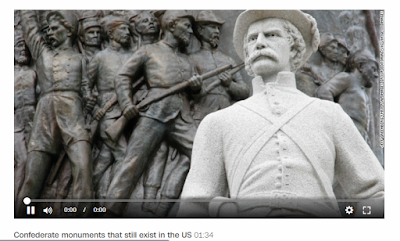
This summer we have been debating about monuments in public spaces – most recently in Charlottesville, Virginia. In doing so, we are thinking about the landscape of our public lives. We are also thinking about how we should live our public lives. Essential to our thinking and reflection is asking questions. Then we will have a growing sense of understanding and a deepening insight.
Gen. Robert E. Lee, Emancipation Park, Charlottesville, Va,
First the individual should visit the site, walk in its territory, touch it, and read it or study it. Ask questions. What is the story of this site? What does the site mean? Reflect. Be open for insight and the beginning of understanding. Search out other sites nearby. Look for connections between sites as you ask questions and reflect. More and more people are using the expression “establish context” (or “discover context”) as they discuss a monument. To establish context, the observer or visitor must ask questions. What happened here? What is the story of this site? What is the historical neighborhood – in both physical space and time? The observer needs to do some detective work.
In the next section I list questions that can help in this detective work. Visitors to Charlottesville, a city of 47,000, may want to test these questions at various sites and look for connections between sites. Following the questions, I suggest a few places (of many) in and near Charlottesville that will produce insights when reflected on and compared.
Questions to consider when visiting a site:
Where is the monument?
Why is it in this location?
When was it placed here?
What is the story behind the monument? Has the story changed since the monument was erected?
What was the purpose of the monument? What is the purpose today?
Who designed it?
Who paid for it?
Has it been moved?
Has it been changed?
Has it been forgotten or ignored?
What is its physical condition? (Should it be repaired or cleaned?)
Do most people know it is here?
Does it continue to be part of public life?
What did it mean when it was first set up?
What does it mean now?
Should it be moved? Where?
Should it be redesignated or rededicated?
What have I discovered by visiting this site?
How significant is the monument to me personally? Why? (Personal reflection.)
Several Sample Sites: Charlottesville, Virginia, Summer 2017
Erected in 1924, an equestrian statue of Robert E. Lee stands in Lee Park (now called Emancipation Park) in Charlottesville, Virginia. Immediately after the Civil War, Lee was asked about the building of a monument to Stonewall Jackson. Lee opposed it because of the expense. Only markers and stones on individual graves would be appropriate, Lee believed.
Furthermore, constructing Confederate monuments would slow down the reunification of the country. Lee was convinced that it was time to rebuild and reunify the county – not build monuments. He even declined to meet with other Confederate and Union officers at Gettysburg to discuss a memorial there. Lee became President of Washington College (now Washington and Lee) shortly after the war in October, 1865, and died in 1870. He is buried in the college chapel.
Not far from the Lee monument, visitors to Court Square can see the Slave Auction Block plaque pointing out the location of the slave market – the place on the streets of Charlottesville where slaves were bought and sold. Nearby is the campus of the University of Virginia with the Rotunda – the great library – the heart of the university with a statue of Thomas Jefferson, the founder and designer of “Virginia’s first truly public university” (“Timeline” see below.), standing in front, holding a copy of the Declaration of Independence.
Fingerprints...see NBC Dateline video below.
A few miles away on “The Little Mountain” – Monticello – where Thomas Jefferson owned over 600 slaves during his lifetime, some changes are being made to reveal the full story of all of the people who lived on the 5,000 acre plantation. Place your own fingers in the fingerprints that slaves left in the bricks when they built the outside wall of the house. Visit the Sally Hemings display, and remember the only slaves that Jefferson freed were the children of Sally Hemings (and himself?). (Monticello is a World Heritage Site.)
In your own hometown – or in the town or city where you live or work today – what are the monuments, markers, places, and sites of memory, meaning, or consequence? What are the connections between them? What are the questions that come to mind when you visit them? What are the stories? What are the contradictions? What are the puzzles? What markers should be added? What insights come to you? In your detective work, what do you find out? What does it all mean?
Background Actually, Robert E. Lee Was Against Erecting Confederate Memorials - CNN - 17 Aug 2017